
How we'd design Singapore's transport grant for large families
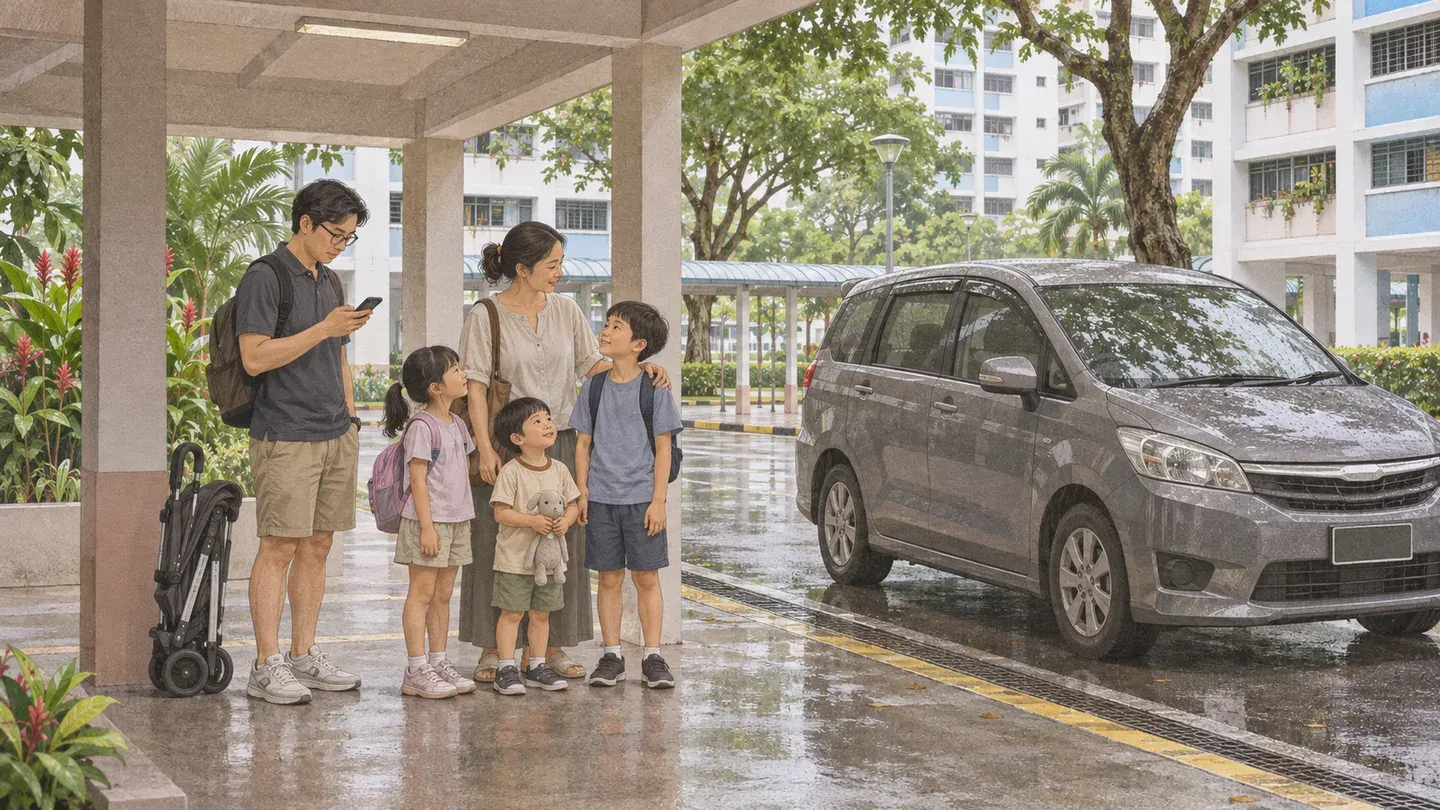
A family of 5 needs 6 seats when someone else drives.
With 2 parents and 3 children, a standard taxi carrying up to 4 passengers won’t fit everyone. Add a stroller and suitable child seats, and booking a ride takes more planning than tapping the cheapest option.
Public transport can work well. But getting children through a bus transfer in the rain, or home when one is tired and another needs carrying, is a different trip from an adult commuting alone.
We’d offer large families up to $300 a month for transport, paid in cash. Help them with the trips that are difficult to manage.
Our proposed grant
Transport Minister Jeffrey Siow said on 3 November that the Government is studying a transport grant. LTA’s consultation paper identifies families with 3 or more Singapore Citizen children as the intended group.
The $300 is our suggested pilot amount, not an announced entitlement. We’d keep the design simple:
| Design choice | Our proposal |
|---|---|
| Who gets it | Families in Singapore raising 3 or more dependent Singapore Citizen children, including single parents and existing families |
| How much | Up to $300 monthly, with more help for lower-income families and those with younger children |
| How it reduces | Gradually as income rises and children grow more independent, avoiding abrupt birthday cutoffs |
| How parents use it | Cash for their choice of transport, with the same entitlement for car owners and non-owners |
A family shouldn’t lose everything when its eldest turns 18 while two younger children still need help getting around. The final rates and eligibility rules need costing before launch.
At an illustrative $30 a ride, $300 covers 5 return trips. At $50, it covers 3. It won’t pay for daily chauffeured school runs, but it could help with a school bus bill or occasional family outings.
If we want more children, make family life easier
Singapore’s resident total fertility rate fell to a record low of 0.87 in 2025. If we want people to feel more confident about having children, helping with the recurring hassle deserves a place alongside the big announcements.
The announced SG Child Support Package, which starts implementation in April 2027, will provide broader financial support. We’d add this grant to it. How generous to make it depends partly on how much we’re willing to spend encouraging larger families.
You could fairly call our proposal another Baby Bonus with a transport label. Parents could spend the cash on groceries, and we’d be helping families who might have had 3 children anyway. Those are weaknesses in the case for calling it a birth-rate incentive.
We can’t promise $300 will persuade anyone to have another baby. Housing, childcare and time away from work don’t disappear because a few rides are covered. The hope is that reliable, practical support makes a larger family feel more manageable for people who already want one.
And it should help the parents already doing it. They shouldn’t need another baby to qualify.
Cash still needs a suitable ride
Eligible young children already travel free on basic public transport. Paying less doesn’t remove the juggling involved in travelling with them.
Families also need rides with enough space and suitable child restraints. Operators should make those options clear before booking. More cash could push fares up if suitable vehicles are scarce; we haven’t established the size of any current shortage.
There are fairness problems too. A parent with 2 children and an elderly relative might need more help than a family with 3 teenagers. Targeting larger families is a choice to support that group, not a claim that everyone else has it easy.
Keeping the grant separate from COE reform lets families benefit without buying a car. Cash gives them room to choose what works that week.
Try it, then check what changed
Every 10,000 families receiving the full $300 monthly would cost $36 million a year, before administration. That’s a scenario, not a count of eligible families.
After 2 years, check whether parents feel less financial pressure and can make trips they previously put off. Track fares and waiting times too. A higher birth rate would be welcome, but it wouldn’t by itself prove this grant worked.
Start by making it easier to get the children home.